Take Me Back Againjohn Cate Take Me Back Again John Cale
"I t looks similar the lesser of the ocean, the light is completely unlike. And the perspective of fourth dimension changes out hither. The days are so long." Down the line, Cate Le Bon is describing the beauty of desert living. "Everything is and then yet," she says. "Audio travels differently out here. It feels like you're in a vacuum, and you choose when you want to break the seal."
She still speaks about the Mojave with the wonderment of a newcomer; the events of the past ii years mean that she has spent peradventure just two months in the domicile she bought in Joshua Tree, California. Instead, she pinged around the globe from Wales to Topanga Canyon, anything to keep working; producing records for John Grant and Devendra Banhart and recording her own sixth album, the spectacular Pompeii, the follow-upwardly to her Mercury-nominated 2019 album Reward.
Since 2008, Le Bon has been one of the almost idiosyncratic musicians in the UK, sought out for collaborations past pop-adjacent peers such as Gruff Rhys, St Vincent, John Cale and Deerhunter. Her own music has depth, strangeness and wonder: ornate synths meet lugubrious contumely, slivers of guitar, kaleidoscopic lyrics and a vocalisation that can exist sweet and dusky, elastic and spooky.
When the starting time murmurings of the pandemic began, Le Bon was due to head to Iceland to begin piece of work on Grant's anthology. This was some while before the restrictions of grounded flights and global lockdowns, and and so she and her longtime collaborator and co-producer Samur Khouja chose to travel "hopefully" to Reykjavik, believing and so that soon it might all pass.
Information technology was only when Warpaint drummer Stella Mozgawa flew out to join the recording sessions that Le Bon began to wonder whether things might be more than serious. Within a day, Mozgawa's parents insisted she had to fly back to Sydney before the borders shut. "That was the moment where we all went: 'Oh shit! This is real! And so on the Wed morning I was driving her through the near alien landscape at 5am to the airport. And we were just both wide-eyed going: what the hell is going on?"
From Iceland, Le Bon watched the world close down, saw live music halt, and friends beyond the arts suddenly having to seek new employment in supermarket warehouses. At the end of Apr she made information technology to the UK to stay at her family's home in westward Wales, a glorious spell of adept atmospheric condition and rare family time. She felt some guilt at her practiced fortune. "Everything felt so calm and you're freed from the agenda of a plan."
Le Bon, Khouja, and Le Bon'south partner, the musician and painter Tim Presley, ended upwardly in a friend'southward house in Cardiff where Le Bon had once lived in her 20s. She talks most the sense of strange familiarity, "remembering instinctively where all the low-cal switches were, and I knew all the sounds of the business firm, and all those things you kind of store in your body, and you offset thinking: what else am I storing that I'm not enlightened of?"
There was the added dichotomy of being "somewhere so familiar but so discrete from information technology all. I'grand in the city where my best friends are, but I'm still talking to them on FaceTime because it was during the lockdown."
This was some altitude from the original plan for this album, which they wanted to record in Chile or Norway, "somewhere where we could be completely removed from anywhere familiar, any comforts. Where we could really lean into shedding, and this thought of becoming invisible because y'all're free of all those things." Le Bon jokes that the piece of work she, Khouja and Presley made in this time could exist seen equally "a production of 3 people losing their minds in a terrace business firm" but it is Le Bon's finest work to appointment – inquisitive, beautiful, witty and wise. "I tried to lean into what John Keats calls 'negative capability'," she says, when asked how the times bled into the songs. "Where you stop striving for reason and you cease trying to solidify things and you lot lean into the anarchy of them. And I guess you lot try to shelve fearfulness, and yous lean into hope and curiosity."
She tried to embrace the absurdity of the situation – "I honey dadaism, and the idea of Cabaret Voltaire and all these things that emerged in really bleak times" – and leaned into the cool for Pompeii'southward lyrics, too. "Absurdity doesn't mean that something doesn't brand sense and it doesn't hateful that something doesn't have emotion," she says. "Absurdity isn't nonsense to me. Frequently writing these things, I knew I didn't fully understand them, merely they felt right, and I knew that they were nigh like letters to my futurity self that would get apparent. And then I simply trusted. You've got to trust your gut."
She listened a not bad deal to Music for Saxofone and Bass Guitar by Sam Gendel and Sam Wilkes – "a record that felt like an extended moment, that you don't really break, where the lighting well-nigh stays the same throughout" – and endeavoured to make something similar. "Where y'all mind to information technology and it tin feel a little claustrophobic, and and then at different times of the day it feels quite freeing and it plays with the perspective of time."
Freed from the usual restrictions of studio bookings, she and Khouja could spend time "deconstructing and reconstructing the songs" over and over. "For me this is the most enjoyable way to brand something," she says. "Where you lot tin start something in the morning time, and by the evening yous've completely changed its character, you've rebuilt it, you've broken it downward and plant the stone that sings, and so you rebuild it around that."
Le Bon has worked with Khouja since he engineered her 2013 quantum Mug Museum. "I've been in studios, would you believe, where men tell you that this isn't possible and you lot're doing something incorrect – like, for fuck's sake. And Samur was just completely devoid of all that bullshit," she says. "We've worked together so much now that sometimes it's just a look, and he knows exactly what I'm thinking. I think perhaps in some other life we could be a detective team."
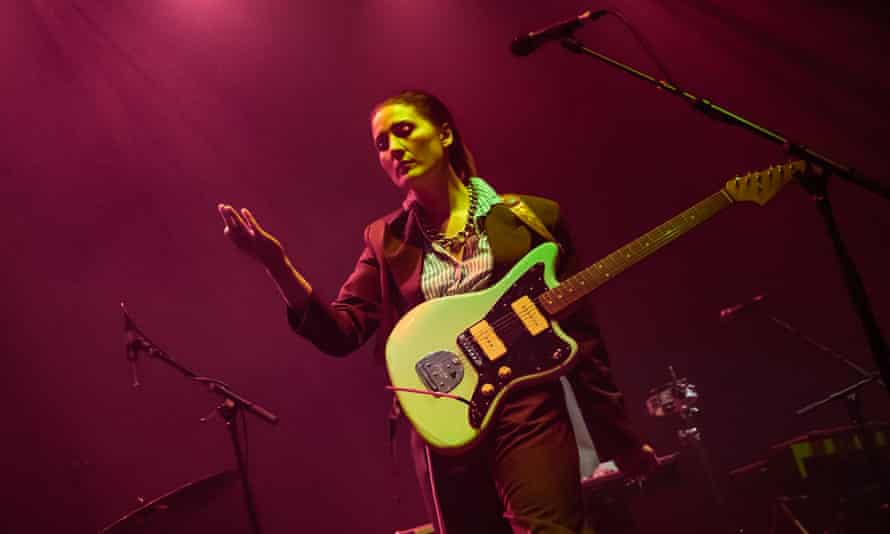
And for all the global restrictions, recording Pompeii was, Le Bon says, "probably the virtually gratis I've felt. In that strange fourth dimension of thinking about all this existential dread and thinking well-nigh the future of music and what you desire for yourself, there'due south this thought that maybe it'due south the last matter you'll always make, or there won't exist anyone to hear this. I could exist dead by the terminate of this. And at that place'due south something quite freeing about that, strangely."
When it came time to record the saxophones, restrictions had lightened. They relocated to a converted chapel studio in west Wales, where they were joined by old friends Euan Hinshelwood and Stephen Black. "Information technology was cute," she says. "We spent 4 days doing saxophones, so on the last dark nosotros drank virtually ten bottles of wine and we danced for vi hours. That joy of being around these people who you realise you need, and to celebrate, because you don't have the words, you only dance."
In the room next door, Presley was busy painting. One afternoon he came into the studio and showed Le Bon and Samur a painting "that just floored us both", she says. "I couldn't terminate thinking about how it hadn't existed that morning when we were having java, and now it exists and it'south having this profound result on united states all. I kept thinking almost what Virginia Woolf calls 'the enormous eye' and that's what he'd accomplished in a style. He'd simply sat downwards, no preconceptions, no exterior influence, just leant into promise and curiosity and allowed himself to create this affair that was really kind of chilling and beautiful, beyond words." The film now graces the cover of Pompeii. It shows Le Bon, wide-eyed in a white habit, part-icon, part Joan of Arc: a moment when the seal was still unbroken.
-
Pompeii is released on 4 February.
Source: https://www.theguardian.com/music/2022/jan/27/i-thought-i-could-be-dead-by-the-end-of-this-cate-le-bon-on-making-art-from-covid-chaos
0 Response to "Take Me Back Againjohn Cate Take Me Back Again John Cale"
Post a Comment