Could a 911 Attack Happen Again
Past Ellen Gilmer
Bloomberg News
NEW YORK — The Sept. xi terrorist attacks left the U.S. with national trauma, two decades of war, and the biggest shuffle of federal hierarchy in American history.
The Department of Homeland Security took shape in the wake of the destruction, pulling together safety and security functions from across the government. The goal: to ensure a nine/eleven-style attack could never happen once again. DHS has since grown to the 3rd-largest Cabinet department, juggling cybersecurity, climate change and other emerging threats while continuing to fight terrorists from within the U.Due south. and away.
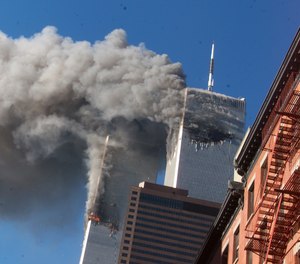
"We accept more than terrorists today than we did on nine/xi," Elizabeth Neumann, DHS' banana secretary for counterterrorism during the Trump administration, told a Senate panel in August. "That'due south very sobering, as a counterterrorism person."
Twenty years afterward the attacks that spurred DHS' creation, is the homeland any safer from terrorism? Is the agency prepared to prevent another 9/eleven — whatever form information technology takes?
Bloomberg Authorities asked five current and former DHS leaders to share their views as the ceremony approaches. Responses accept been edited and condensed for clarity.
Secretarial assistant Michael Chertoff (Bush 2005-09)
You're nearly hesitant to say we are safer, or less; it's such a dynamic situation in the earth. We built a structure that would make it much more hard for international terrorists to acquit out a 9/11 on the scale of what we had twenty years ago. Nosotros haven't had an attack of that scale since 9/11, and we've also been very proficient about keeping dangerous people out of the country.
That being said, though, nosotros've had new threats that have emerged. The scale of those is less than a 9/11, thank God, just we've seen a number of cases where extremists on the right have committed acts of violence confronting people at a synagogue or a church. We've too had situations where jihadi sympathizers have been inspired to deport out attacks.
[RELATED: ix/11: Reflections at 20 years]
A business organization that we're now going to exist starting to worry virtually with Afghanistan is when the jihadis really have control over territory, that gives them an opportunity to railroad train people and experiment with laboratories and weapons. Nosotros're going to accept to be more vigilant at present about the possibility of experimenting with weapons of mass devastation or biological or chemical weapons. Every bit we saw in Afghanistan 20 years ago when we went in, we found labs and training camps that the jihadis were using to attempt and come up with devastating weapons.
DHS is going to be quite busy, as they take been throughout the entire beingness of the section. And to add to that, the domestic terrorism issue has past no ways gone abroad. In fact, it's intensifying, so there'southward going to take to be both the ability to look overseas, merely also the power to look at habitation.
Secretarial assistant Janet Napolitano (Obama 2009-13)
Are there some things that we're safer on now than we were on 9/11? Absolutely. Are there new risks that have evolved or multiplied or grown since 9/xi? Absolutely. To put information technology shortly, on some things, we're definitely safer. On aviation security, it's really difficult to imagine how passengers could actually accept over a commercial airliner and weaponize it the mode they did on 9/eleven.
But risks are not static. It's a constantly changing environment, so some risks have grown, like cybersecurity. The risks from domestic groups accept grown, the number of the groups and their activities take grown. Risks that are related to information, misinformation, disinformation on social media and how that undercuts trust in our institutions, that'due south grown. It's a different hazard environment.
DHS needs to continue to exist agile and to adapt. They need to keep to invest in their analytic adequacy and in new technologies that can assist usa empathise the risks that confront us. In the midst of however trying to harness this huge behemoth of a section, they need to go on to piece of work on creating a sense of unity of endeavor and articulate goal-setting. They need to avert the temptation to be just the Section of the Southwest Border. Their statutory mission is so much broader.
Secretarial assistant Jeh Johnson (Obama 2013-17)
DHS was created in 2002 on the supposition that the terrorist threat to our homeland was extraterritorial, that it was beyond our borders, and therefore if we consolidate into one cabinet-level department the regulation of all the different ways someone tin can enter our country, we've effectively dealt with terrorism.
Now the principal threat is the threat of violent white nationalism here in the United States. That is not a threat that the current DHS is equipped to deal with. You don't have a lot of DHS cops running around in the interior looking for domestic-based terrorists, and I'm not sure that in that location should be. That chore has fallen principally to the FBI.
In my time in office every bit this threat was evolving, I spent a lot of time on countering violent extremism here at domicile — meeting with customs organizations, local law enforcement in major metropolitan areas around the country to aid build relationships with organizations defended to countering trigger-happy extremism. The way DHS influences that space is through grant-making authority, countering fierce extremism activity, and intelligence-sharing with local constabulary enforcement.
If I were king, and I'grand not, I would decree a consolidation of all of the federal law enforcement agencies into one department of public safety, modeled after the way they do things in other countries. I would consolidate all of that into one place, deconflict their missions, requite them ane intelligence collection directorate to support all the law enforcement. But many people would regard that as too big, and information technology will never happen. But that would be the about constructive mode to deal with whatever type of domestic-based terrorist threat to our homeland.
DHS was a political compromise like everything in Washington. In some respects, it didn't become far enough. In other respects, it went besides far.
Interim Secretary Chad Wolf (Trump 2019-21)
At that place'due south been a lot of progress fabricated at the department regarding homeland security over the concluding 20 years. We are leaps and bounds from where we were on the morning of 9/11. We have a lot more infrastructure, a lot more vetting, a lot more intel-collecting taking identify. There'southward a lot of robust systems established over the last twenty years through the department's efforts.
That being said, just in the final vii months, there are a couple things that requite me suspension. The edge is a practiced example of that. Nosotros haven't seen these numbers since 2001. The department's never had to deal with the influx of people we meet on the southern border month in and month out. The national security element of what's going on at that place is beingness overlooked. And what'south going on in Afghanistan is very concerning. I'm concerned nosotros're non as safe and secure as we were four or v years agone, given the decision-making and some of the real-earth things going on today.
They are overly focused on domestic terrorism. If you were to ask most politicals at the department today, they would say it's the No. 1 threat to the homeland. It'south absurd to say that'south the most pressing threat to the homeland. It is a concern, it is a threat, but not the most pressing threat. They need to start focusing on their core competencies: continuing to ameliorate the vetting, the screening, the counterterrorism tools at the section. You've got to continue refining those.
Secretary Alejandro Mayorkas (Biden 2021-present)
The terrorism-related threat has evolved over the years. When I began in 2009 in the section, information technology was the foreign-fighter threat. The private would seek to enter the United States and do the states harm. It evolved, when I became the deputy secretary, to the homegrown trigger-happy extremists; the individual radicalized past, for instance, ISIS credo via the cyberspace.
It is now what would be termed the domestic violent extremists: fake narratives, ideologies of hate, an individual here drawn to violence by reason of false narratives, those ideologies of hate, and other extreme views. The question I ask is, can we address the threat equally information technology exists at present? Yes.
Nosotros have issued bulletins to local first responders in communities. We've issued alerts, we're disseminating information more ably than in the prior years. We've created a domestic terrorism unit of measurement. We have a domestic terrorism strategy. We've dedicated for the first time grant funds specifically to address this with a minimum of $77 million. Yes, we are meeting the challenge, just what will be the adjacent evolution? Are we poised at present, do we have the infrastructure to address what might come tomorrow? When I asked that question, 1 of the answers was our infrastructure — the Information technology system we have to push information out — needs improvement. So we invested in it.
Many studies take been conducted nigh the department over the years, and whether it needs to exist reformed. We welcome those recommendations, whether they are past recollect tanks, the legislature, or others. I draw ideas from those discussions. I read the unlike variations of the reform bills. There are things with which I concur, things with which I don't. It's a procedure. I appreciate, frankly, the focus on the well-being of the department.
Adjacent: Address the vulnerabilities in your backyard: Terrorism preparedness for rural agencies
©2021 Bloomberg L.P. Visit bloomberg.com. Distributed by Tribune Content Bureau, LLC.
McClatchy-Tribune News Service
Source: https://www.police1.com/federal-law-enforcement/articles/are-we-safer-now-homeland-security-leaders-reflect-20-years-after-911-kuL8hTTna1AvxVrC/
0 Response to "Could a 911 Attack Happen Again"
Post a Comment